




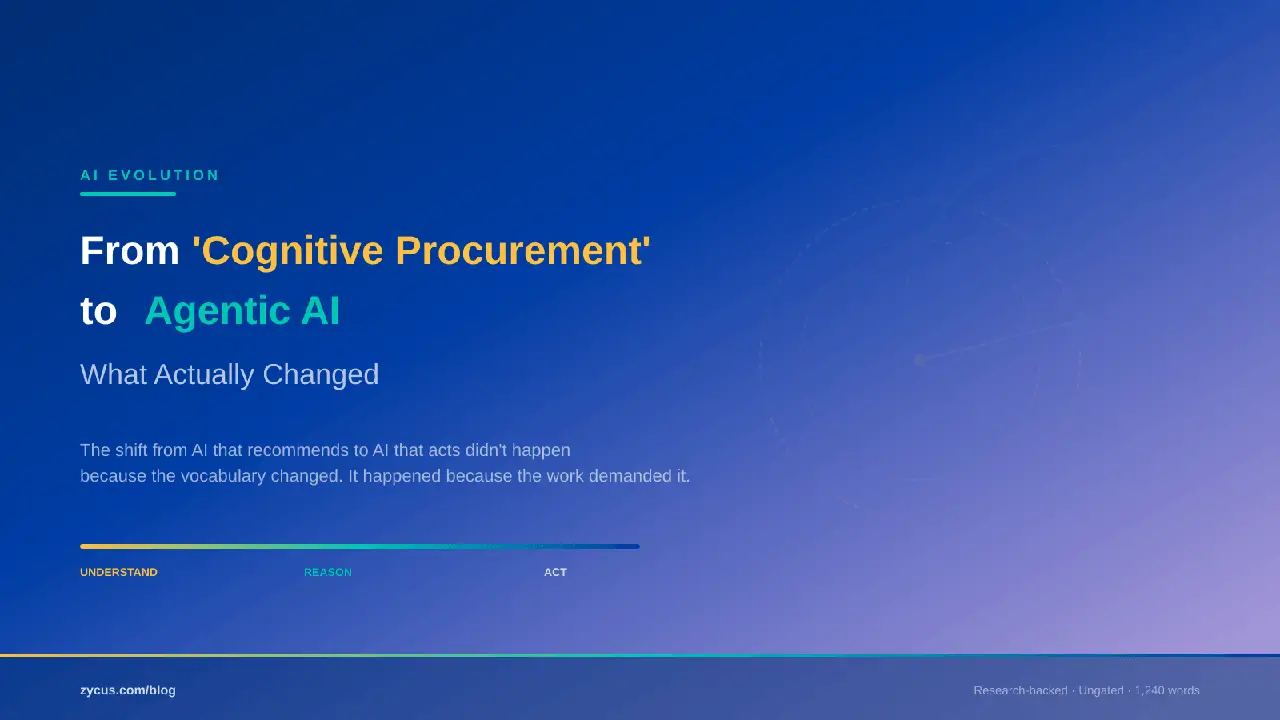

The shift from AI that recommends to AI that acts didn’t happen because the vocabulary changed. It happened because the work demanded it.
TL;DR
- McKinsey names the shift from Cognitive Procurement to Agentic AI in seven words: from “Show me the data” to “Do it for me.” That is the distance between the two eras.
- Cognitive AI was genuinely useful — but it generated recommendations faster than humans could act on them. Override rates between 33% and 96% are documented in comparable domains.
- Three technical breakthroughs made agentic AI possible: large language models (unstructured input), tool use (system action), and MCP (universal connectivity). None existed in the cognitive era.
- Early agentic deployments deliver 20–30% staff efficiency gains and 1–3% additional value capture — and 76% of organizations report 25%+ improvement in key procurement metrics.
- Agentic AI without domain intelligence is automation in a language-model costume. The cognitive foundation — classification, spend taxonomies, supplier intelligence — is what makes agents smart.
- The shift is not a rebrand. It is a graduation — from AI that shows you the answer to AI that delivers the outcome.
McKinsey recently gave the shift a name that sticks. For years, procurement AI was about “Show me the data” — surfacing insights, scoring risks, classifying spend, recommending actions. The new era is about “Do it for me.” That single pivot — from AI that informs to AI that executes — is the most consequential change in procurement technology in a decade. And it didn’t happen because someone invented a better chatbot. It happened because the old model stopped working.
Agentic AI refers to systems that execute procurement work autonomously within defined guardrails, rather than recommending actions for human execution.
Why did Cognitive AI Stop Being Enough?
The first generation of AI in procurement — often branded as “cognitive” or “intelligent” — was genuinely useful. Machine learning classified spend with accuracy humans couldn’t match. Risk scoring surfaced supplier vulnerabilities before they became crises. Contract analytics extracted obligations from documents that nobody had read in years. All of it generated recommendations. And all of it depended on a human to review, decide, and act.
The problem wasn’t accuracy. It was volume. Clinical decision support research has documented this pattern with unusual precision: when AI-generated alerts exceed a certain threshold, professionals begin ignoring them — override rates between 33% and 96% are common, even for warnings flagged as critical. One study found a single hospital’s 66 adult ICU beds generated more than two million alerts in a month. Procurement teams experienced their own version: dashboards full of insights, risk scores that refreshed weekly, anomaly flags that accumulated faster than anyone could review them. The AI was right. The humans were overwhelmed. And the recommendations sat there.
Meanwhile, the work kept growing. The Hackett Group’s 2026 Key Issues Study reports that procurement workloads are projected to increase by 8% this year, even as headcount and operating budgets decline. McKinsey’s survey data is sharper still: 55% of procurement leaders report flat or shrinking budgets — while 100% face increased savings targets. Spend managed per FTE is roughly 50% higher than five years ago. A function that was already stretched thin was being asked to absorb more work with fewer people — and the AI it had bought was adding to the cognitive load rather than relieving it.
What Technologies Enabled Agentic AI?
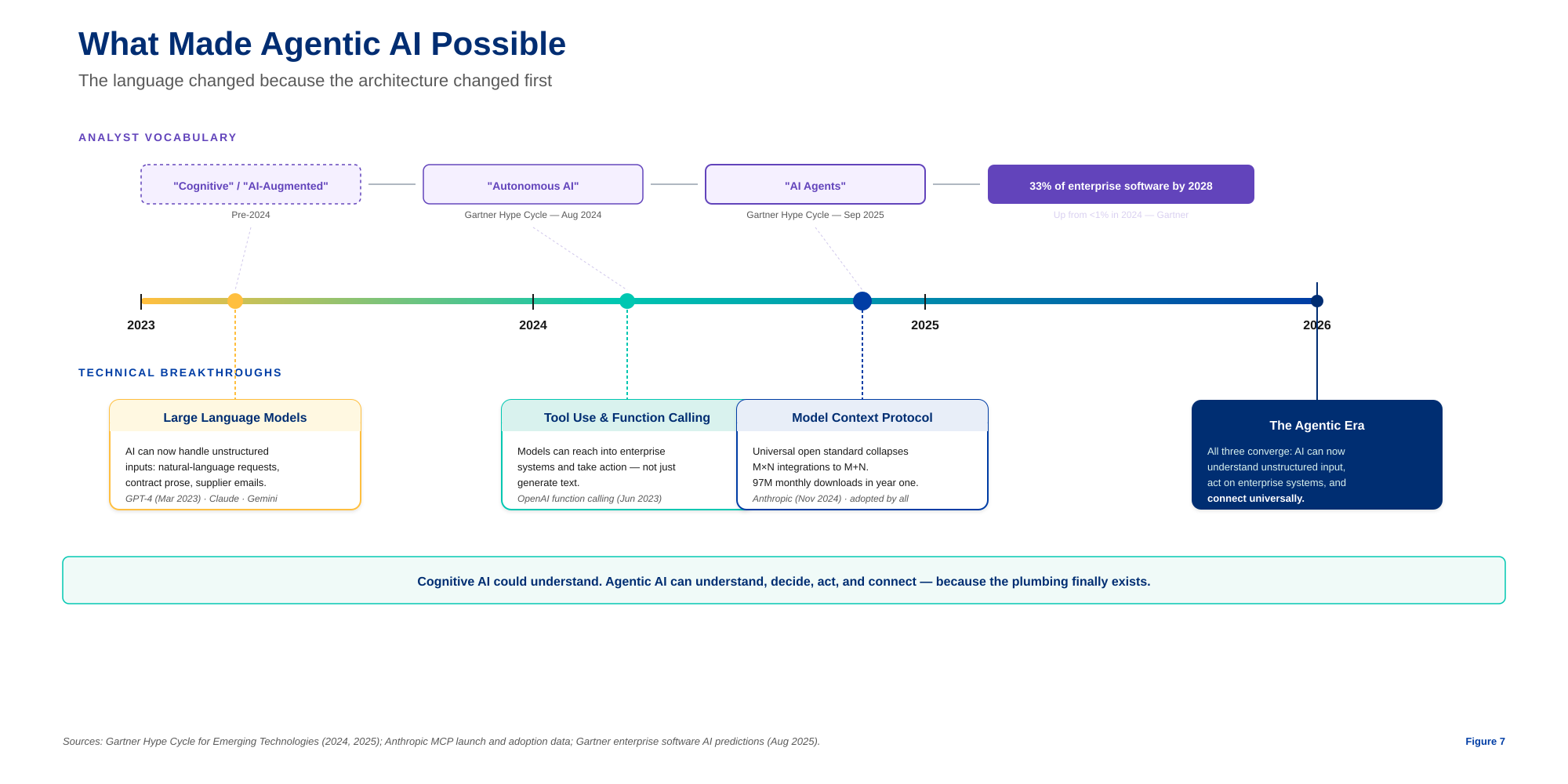
The vocabulary shifted fast. Gartner introduced “autonomous AI” as a headline category in its 2024 Hype Cycle for Emerging Technologies. Twelve months later, the 2025 Hype Cycle replaced it with “AI Agents” — a debut at the Peak of Inflated Expectations, less than a year after the category existed at all. Gartner now projects that 33% of enterprise software will include agentic AI by 2028, up from less than 1% in 2024. The terminology moved so quickly that some organizations are still writing their “cognitive AI strategy” while the analyst community has already moved two generations ahead.
Read more: Beyond Automation: The Future of Human-AI Collaboration in Procurement
But the real change wasn’t linguistic. It was architectural. Three things happened between 2023 and 2025 that made agentic AI possible in a way it simply wasn’t before. Large language models gave AI the ability to handle unstructured inputs — natural-language purchase requests, contract clauses in legal prose, supplier emails — that earlier ML systems could not. Tool use and function calling gave models the ability to reach into enterprise systems and take action, not just generate text. In November 2024, Anthropic released the Model Context Protocol (MCP) — an open standard that collapsed the integration problem from M×N custom connectors to M+N standard ones. Adoption was immediate. Within a year, MCP reached 97 million monthly SDK downloads and over 16,000 active servers. OpenAI, Google, and Microsoft all adopted it. The plumbing that lets AI act — not just think — finally existed.
Figure 1 — What made agentic AI possible: the language changed because the architecture changed first.
What the Shift Looks Like in Procurement
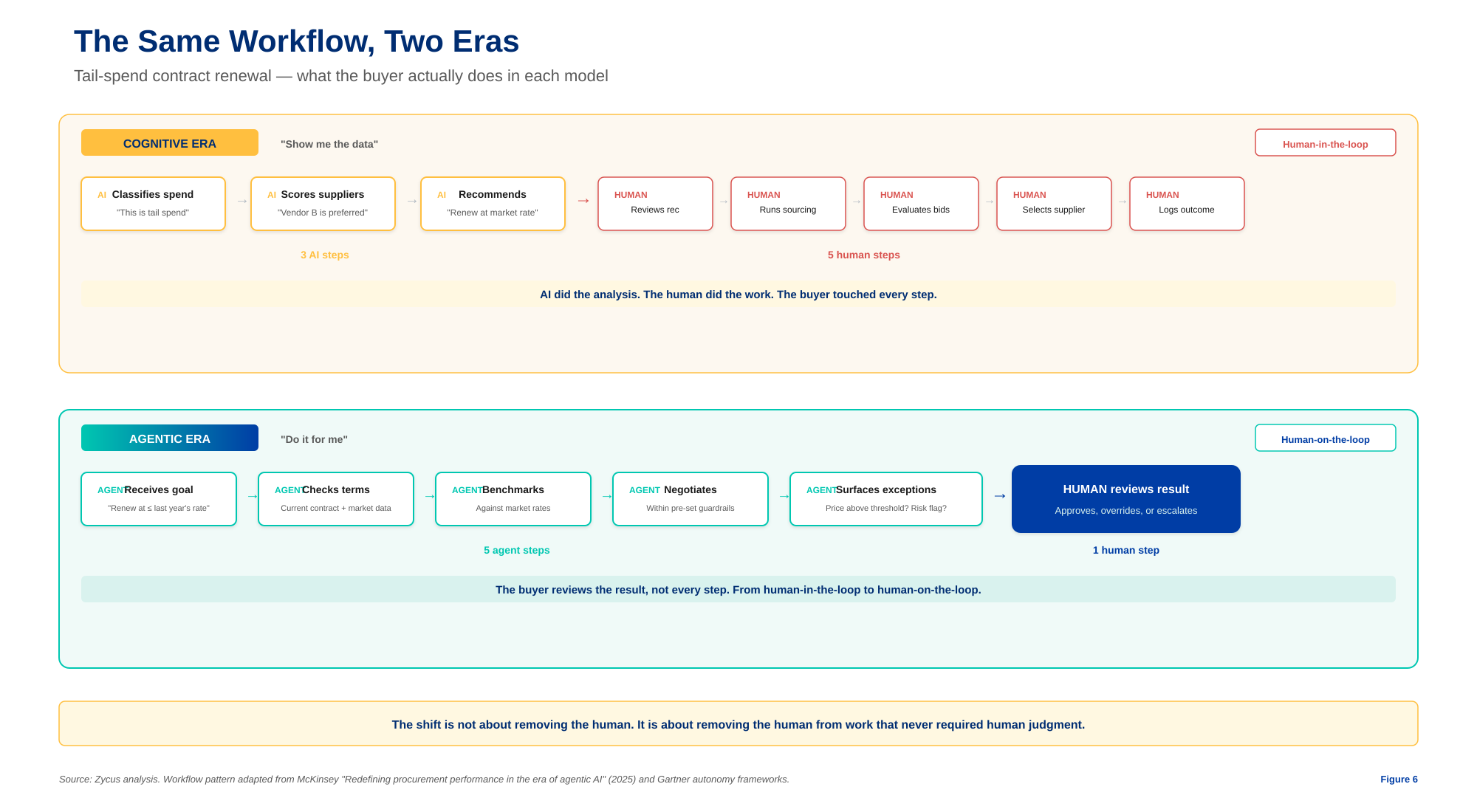
The easiest way to understand the difference is to follow a single workflow through both eras. In the cognitive model, an AI system might classify a purchase as “tail spend,” score the preferred suppliers, and surface a recommendation. A buyer would review the recommendation, check it against their own knowledge, open the sourcing tool, run the event, evaluate the bids, select a supplier, and log the outcome. The AI did the analysis. The human did the work.
In the agentic model, the system receives a purchasing goal — “renew the janitorial services contract for three facilities at or below last year’s rate” — and executes. It checks the current contract terms, benchmarks against market rates, drafts the negotiation parameters, engages the supplier within pre-set guardrails, and surfaces only the exceptions that require human judgment: a price above threshold, a supplier flagged for risk, a term that deviates from policy. The buyer doesn’t review every step. They review the result. The shift is from human-in-the-loop to human-on-the-loop — still accountable, still in control, but no longer manually operating every stage.
Figure 2 — The same workflow, two eras: from human-in-the-loop to human-on-the-loop.
The evidence is accumulating rapidly. McKinsey reports that early agentic deployments are delivering 20–30% procurement staff efficiency gains and 1–3% additional value capture. In one deployment, a global pharmaceutical company working with Zycus’s AI invoice-to-contract reconciliation tool — built as a four-week proof of concept — identified more than $10 million in value leakage. The Hackett Group reports that. These are not theoretical projections. They are production results from teams that moved past the recommendation layer.
The Foundation that Makes it Work
Here is the part most vendor marketing leaves out: agentic AI without domain intelligence underneath it is not agentic. It is automation with a language model on top. An agent that negotiates a tail-spend contract needs to understand commodity pricing, supplier reliability, contract templates, compliance requirements, and organizational policy — not because a prompt tells it to, but because that understanding is embedded in the data core the agent was trained on. The classification accuracy of the cognitive era, the spend taxonomies, the supplier intelligence, the contract ontologies — all of it becomes the substrate the agent reasons against.
IBM learned this when it transitioned from Watson to watsonx. The cognitive layer wasn’t discarded; it was rebuilt into three architecturally distinct components — foundation models, a data store, and a governance layer — that turned Watson’s accumulated intelligence into infrastructure for autonomous action. The generative AI book of business grew from the low hundreds of millions to approximately $12 billion within two years. The lesson is transferable: the organizations that invested in data infrastructure during the cognitive era are the ones best positioned for the agentic transition. The understanding was never wasted. It was the foundation.
Platforms built this way — Zycus’s Merlin among them — treat cognitive-era capabilities (classification, extraction, risk scoring) as the intelligence layer beneath agentic-era capabilities (autonomous negotiation, intake orchestration, touchless processing). The question for procurement leaders evaluating any vendor is the same one IBM had to answer internally: is the intelligence earned through years of domain-specific deployment, or is it a general-purpose model wearing a procurement costume?
Philip Ideson of Art of Procurement has given this destination a name: “invisible procurement” — a future where the buying process moves back to stakeholders, orchestrated by AI agents, with procurement’s expertise embedded in the guardrails rather than performed in the manual steps. Generative AI helps you think faster, as Art of Procurement puts it. Agentic AI helps you act faster. The shift from cognitive to agentic is not a rebrand. It is the difference between showing someone the answer and delivering the outcome.
The function that spent a decade building intelligence is now learning to let that intelligence act. That is not a pivot. It is a graduation, and agentic AI is the execution layer of an intake-to-outcomes architecture that turns that intelligence into resolved business outcomes.
Related Reads:
- Why Agentic AI Is the Future of Source-to-Pay Automation by 2026
- The Complete Guide to Agentic AI in Procurement
- From Intake to Outcomes: How Agentic AI Is Transforming the Source-to-Pay Lifecycle
- The First 12 Months of Agentic AI: A Practical Roadmap for CPOs
- Top Use Cases of Agentic AI in Procurement (with Real Examples)
- Agentic AI in Procurement
- Magazine: Intake to Outcomes (I2O) with Agentic AI-powered Procurement